Q: I heard or read somewhere that you suggest going real heavy on the last set of a TORQ sequence for only 5 or 6 reps. I want to try it, but I am over 40. How do I do it safely, without joint damage or muscle pulls?
A: Just as a review, here’s how to do a Power TORQ (tension-overload repetition quantity) sequence…
Set 1: Take your 30-rep max and get 30 reps–go to failure. Add weight as you rest for 45 seconds…
Set 2: Take the heavier weight and try to get 20 reps–go to failure. Now add significantly more weight as you rest for 1 1/2 minutes…
Set 3: Rep out, getting anywhere from 5 to 8 reps. If you get 8, you’ll need to use more weight on this set next time.
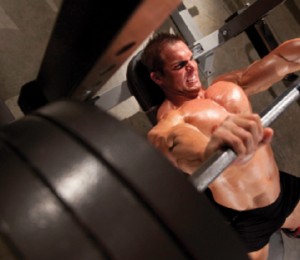 Is that safe for older trainees? For most we say yes. That’s because the first two high-rep sets with the short rest between will pool plenty of fatigue products in the target muscle…
That means that the weight you use on set 3 for around 5 reps will NOT be your real 5RM; it will have to be quite a bit lighter due to pre-fatigue, lactic acid, etc.
Still, keep the set strict–lift in 1 to 1.5 seconds and lower in 3. And no jerking or heaving. This isn’t about lifting as much weight as possible, it’s about activating the max amount of growth fibers.
Another variation would be to add less weight for set 3 and do a speed, or X-celeration, set. That is, make EACH rep last only about 1.5 seconds. The weight should allow about 15 of those speed reps (that will be heavier than your standard 15-rep TORQ set)…
That style of training has been found to activate the type 2B growth fibers, very similar to a heavy set. But even thought the weight is fairly light, still be VERY careful. Yes, you should move fast on every rep, but stay in control–no throwing the weight. Remember, each rep should last 1.5 to 2 seconds, not half a second.
That’s two excellent Power TORQ variations to trigger new mass creation–even for the older generation.
Till next time, train hard–and smart–for BIG results.
–Steve Holman and Jonathan Lawson
X-Rep.com