While Arthur Jones, inventor of Nautilus machines, wasn’t always right, and he’d call you a fool if you said he was wrong, his ideas on limited recovery ability are on the money. Here’s a quote from his 1971 Nautilus Bulletin #2:
No amount of stimulation will produce growth if the body cannot supply the requirements for such growth—and the body cannot supply the requirements for growth if they are unavailable; unavailable, perhaps, because they are constantly being used up as fast as they are being produced in never ceasing attempts to compensate for too much exercise.
While Jones and pro bodybuilder Mike Mentzer hammered on the concept of training harder but briefer, new research is suggesting that you can train too hard even if your workouts are fairly brief.
Mentzer realized that after he retired from bodybuilding and began training people. Here’s what he said in a 1991 interview…
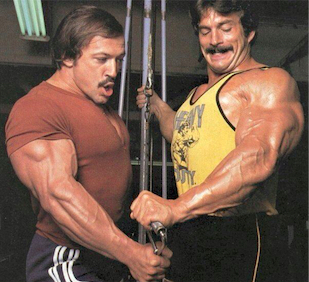
You’ve got to be very careful with this high-intensity stuff. I’m beginning to understand just how demanding it is. Much more biochemical resources are used up. I will often have a trainee do a second set of an exercise, but I’m realizing that increase is wrong. It’s way too much. Rather than have someone do a second set, maybe do one extra rep. When you start making increments in volume, you have to start out very, very small. The demand from even that one set to failure is of an enormous magnitude.
Of course, each individual has their own capacity for work—some can tolerate a lot, others only a little. Even so, if you’re a hardgainer type and/or older, you should be more of an intensity minimalist.
Muscle damage can slow or even reverse your gains, especially if you’re not on anabolic steroids…
But don’t studies show that muscle damage increases muscle-protein synthesis which proves that it enhances growth? That’s a conclusion most scientists embraced until recently. Here’s researcher Chris Beardsley take…
Popular study design in which post-workout elevations in muscle protein synthesis are measured may not be as useful as we had previously hoped. Since muscle protein synthesis rates are increased, both in order to repair muscle damage (which does not enhance hypertrophy) and also to increase muscle fiber protein content (which causes hypertrophy), such studies may lead us to conclude incorrectly that more muscle-damaging workouts lead to greater muscle growth.
According to Beardsley, what is really happening is that protein synthesis must first repair all muscle damage. The more damage, the more this process goes toward repair, and less is left for muscle-size increases.
It’s becoming more and more clear that a lot, if not most, bodybuilders are doing too much damage in the gym at every workout. And they are training the muscle before it is repaired, much less supercompensated for hypertrophy to occur.
Could that be why muscle growth is so painfully slow?
In the next newsletter, I’ll have Jones’ amazing personal account of packing on pounds of muscle in only a few weeks with one simple workout tweak after years of slow to no progress. It’s a monster motivator and an eye-opener.
New: Get the ideal exercise for each muscle, the best add-on moves for ultimate mass, complete 35-minute workouts, exercise start/finish photos, and details on building muscle fast and efficiently in Old Man, Young Muscle.
And you still get The Muscle-On, Belly-Gone “Diet” ebook FREE for a limited time when you add Old Man, Young Muscle to your mass-building library. Go HERE.
Till next time, train hard—and smart—for BIG results.
Steve Holman
Former Editor in Chief, Iron Man Magazine
www.X-Rep.com
Recommended
Get Your FREE Protein Powder!
One of our favorite proteins has a try-it-free, no-strings offer, and we don’t want you to miss out. No, this is not a trick or scam—it’s simply a way for BioTrust to get you to try their great Low-Carb protein, no strings whatsoever (just pay a small shipping cost). We’re not kidding…This is an incredible offer, but there’s a limited supply, so grab yours today before the offer runs out** —and it’s delicious, by the way!
–> Secure Your FREE Container NOW! (limited inventory)
**One free container per household