This newsletter often waves the caution flag about muscle damage and how it can prolong recovery and even derail growth.
When you create a lot of damage during your workout, which most bodybuilders do continuously, that damage must be repaired before hypertrophy can happen.
And therein may lie the answer to why muscle growth is so slow for most—if anabolic drugs aren’t involved.
If you train a muscle before it’s fully recovered, you’re spinning your wheels—little to no growth has occurred and you’ve piled on more damage.
So is muscle soreness a good indicator of too much trauma? Many trainees don’t feel as though they’ve stimulated growth unless they get sore.
Soreness does instill a sense of accomplishment, not to mention screams when you sit down on the toilet…
The question is, should you strive for it? Not necessarily…
Muscle soreness is an indicator of damage, but it doesn’t mean you’ve done too much. In fact, if you haven’t done a stretch-position exercise, like say dumbbell flyes, in a while, even one set can get you sore…

But once the soreness is gone, you should be healed enough to train again—although there may be residual damage that you can’t feel.
I’m not a fan of training a muscle when it’s still even a little sore. It’s like scratching off the scab of a cut. Sure, if it’s on your face and you want a scar to look tough, go ahead and scratch. But inside the muscle is a different story…
In the next training newsletter, we’ll look at the theories on why muscles get sore and if it helps your mass development to push for it in the gym.
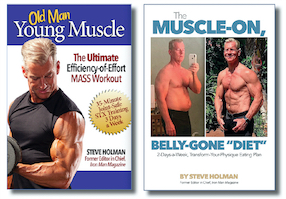
Your Efficient Mass-Building Handbook: For complete mass workouts that include Speed Sets, the ideal exercise for each muscle, and the best stretch and contracted add-on moves, get your copy of Old Man, Young Muscle.
And you still get The Muscle-On, Belly-Gone “Diet” ebook FREE for a limited time when you add Old Man, Young Muscle to your mass-building library. Go HERE.