Beyond X-Rep Muscle Building E-book Excerpt Analyzing Mr. Olympia’s Workout From an X-Rep Perspective
Throughout this e-book we’ve mentioned how Ronnie Coleman, Mr. Olympia, trains with an emphasis on semistretched overload. Those observations were the result of watching his latest DVD, “The Cost of Redemption,” which is an ungodly display of muscle mass and raw strength captured by videographer Mitsuru Okabe. In fact, his mass-training style is a prime example of max-force-point overload on almost every exercise.
 Remember, the max-force point is the place along an exercise’s stroke at which the target muscle has the most power-output potential. It’s essentially the most important point of any movement because it’s where the most fiber activation can occur—more force equals maximum muscle involvement. Where is that point? Well, it’s usually near the semistretched position, near the turnaround of a rep—almost at the bottom of an incline press, for example.
When a muscle is semistretched—not fully stretched, but almost—the muscle fibers are perfectly aligned for ultimate power generation. In simple terms, if you want to trigger extreme mass, you need to overload that point somehow. Coleman does that instinctively with heavy partial-range reps. For example, he does only the bottom half of a bench press stroke. In fact, he almost never does full-range reps. That means he slams that mass-morphing sweet spot with severe overload on every single rep. To drive home that point, we thought it would be interesting to discuss his workout day by day…
Workout 1
Calves. He begins with seated calf raises, and the first thing that’s noteworthy is that he never gets close to full contraction—not even on his first, lighter sets. He works from just above the middle of the stroke to down just short of full stretch—the semistretched point. He does the same thing on one-leg leg press calf raises; however, it’s interesting to note that on all calf exercises, even the seated variety, he double bounces when he gets to the highest point, which for him is just above the middle of the stroke. There is still some stretch in the calf muscle at that point, but not as much as closer to the bottom of the stroke, as dictated by X-Rep protocol.
So from a scientific standpoint he might get better results double-clutching at the semistretched point, down near the bottom where the most fiber activation can occur (the Double-X Overload technique). That’s exactly how he trains his shrugs, double-dipping at the bottom stretch and then only moving the bar up a few inches before he lowers and double bangs again—and his traps are absolutely enormous! Could his calves get even better with extra semistretched-point overload? We think so. (Incidentally, as we’ve mentioned a number of places in this e-book, Jay Cutler, Coleman’s biggest nemesis in his quest for more Olympia titles, uses the Double-X-Overload technique on almost every set, holding and hitching at the semistretched point between groups of reps or single reps. As we said, he may be triggering hyperplasia, or fiber splitting, instinctively at every workout thanks to that unique tweak that has the power to create a freak physique!)
Delts. He kicks off shoulder work with seated dumbbell presses, using a seat with back support. He drives the dumbbells from ear level, the semistretched point, to about eight inches above his head, far short of lockout. (It’s during this exercise that you get to hear his first surprising and somewhat humorous battle cry, “Yeah, buddy!” He loves that stuff, no matter how painful the set.)
He does four sets of partial-range dumbbell presses, increasing the weight on each till he’s using the 160s on his last set for seven reps. (Yes, 160-pound dumbbells!) His first three sets are all in the 10-to-12-rep range. It was rather shocking to see that Coleman prefers higher reps on almost all of his sets, but it’s probably to hammer the target muscle with more tension time.
Speaking of higher reps, here’s a big surprise: After dumbbell presses he goes to the Nautilus double-shoulder machine and does lateral raises, only the bottom half of the movement (semistretched point again), for about 20 reps. Then he follows immediately with presses on the machine, turning his palms out (ouch) and moving the bar from ear level to just above his head, no lockout, for about 20 reps. He does three of the high-rep combo sets—and his delts get pumped to the extreme.
For front delts he does a few progressively heavier sets of alternate dumbbell front raises, stopping each rep at about eye level. His reps start at 15 on the first set and creep down from there.
Uncrossovers are next. What the heck is an uncrossover? We explained them in the X Q&A section, but here’s a quick review: You stand in the middle of a cable crossover, the cable handle from the opposite side in each hand, your arms crossed at midforearm in front of your face with a slight bend at each elbow. You uncross your arms and drive your hands out to your sides at shoulder level, keeping the slight bend at the elbows. After a few reps you should get a wicked burn in your rear-delt heads and midback. Coleman does four sets, increasing the weight on each and decreasing his reps, going from 15 down to eight.
Next it’s bent-over cable laterals in the same crossover machine but using the low handles—and zero full-range reps. He does only half reps from the stretch point to about halfway up. In other words, his arms never get close to parallel to the floor for complete contraction. He does four sets of these stretch-emphasis delt/back burners.
Are you seeing a pattern? The stretched and semistretched points appear to be critically important for building mass. Coleman’s training indicates that in a big way—even more strongly on the next exercise.
Traps. To finish, he blasts out heavy behind-the-back barbell shrugs. He does them while holding the Olympic bar behind his legs rather than in front, and he uses a tremendous poundage that rattles the power rack at the end of his sets; however, his shoulders barely move. He only does bottom-range partials—and his traps look like eight-ton boulders sitting on his shoulders.
He starts with 445 pounds and does 15 reps. Then he bumps it up to 645 for 12 and, finally, 735 for 11. And as mentioned above, he double-clutches at the bottom, stretched position on every rep, providing serious Double-X Overload at the max-force point.
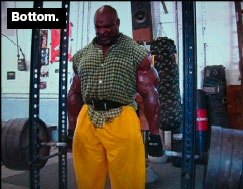
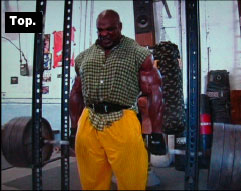
Our primary thought at the end of his workout, other than shock and awe, was this: Considering the impressiveness of his traps, which may be his freakiest bodypart, we wonder why he doesn’t try the double-clutch semistretched-overload tactic on more of his exercises. Could it make him even larger? Scary thought.
Note: The above is an analysis of Workout 1 from Ronnie Coleman’s Olympia mass-training program, as depicted on his “Redemption” DVD. For more analysis and Workouts 2, 3 and 4, see Bonus Chapter A in the Beyond X-Rep Muscle-Building e-book.