“You gotta feel the muscle working if you want it to grow.” So say many of the biggest, freakiest bodybuilders. Trainees in search of big and ripped muscle interpret that to mean that they need to slow down their reps to a snail’s pace. Not true. Once again, it’s a case of watch, don’t ask, or you could go down the wrong road. The champs rarely do slow reps; usually they’re more like the pistons in a car engine. So what the heck do they mean by “feel the muscle?”
They mean to put the target muscle in a stranglehold; use continuous tension to choke off blood flow long enough so you get critical occlusion and a searing burn [we discuss the incredible size and strength results researchers are getting with occlusion in our Beyond X e-book). Take Jay Cutler, the new Mr. Olympia. If you watch him train, you’ll see that he uses explosive-but-controlled reps. But you also may say, “Ah ha, he pauses between reps or groups of reps and rests the muscle.” No. Look closer…
 For example, on seated dumbbell presses he blasts out six continuous-tension reps—he doesn’t lock out at the top and blasts out of the bottom semistretched position, the key max-force point we’re always harping on. After rep six, he pauses—but not at the top lockout where the muscle can rest and get blood; he pause/pulses the dumbbells near the bottom semistretched point so tensions stays on the delts (see photo). He uses that Double-X Overload technique between each of his last four reps, so his set looks like 6-1-1-1.
Talk about feeling the muscle! Those X-Rep pause/pulses build on the burn because they maintain tension on the target muscle right at the X Spot. The muscle isn’t resting, it’s screaming! And while it may appear that he’s only doing nine reps, the pause/pulses in the semistretched position extend the set so the time under tension is more like a set of 12 to 15 reps. (There’s another mass-building lesson from watching, not asking: Even when he does lower reps, like seven, he uses DXO to extend the set into 10-rep territory, the critical mass-building time-zone we’ve mentioned before.)
We stumbled onto the Double-X Overload technique last summer when we were trying to increase our intensity over standard X Reps. We used an X Rep between each standard rep on some of our exercises—and our mass gains took a quantum leap! Months later when we saw Jay Cutler’s “Ripped to Shreds” DVD we were stunned! He was using DXO on almost every exercise—between every rep or groups of reps—to increase the tension time and “feel” the muscle working due to better occlusion and max-force-point overload. (He was the American Indian to our Columbus—we were talking about DXO like we discovered it, but he was there first!)
We’ve noticed that the DXO technique between every rep can triple the effectiveness of some exercises. For example, on cable upright rows, there’s a natural tendency to disengage your delts at the bottom, arms-extended position; however, when you double pump there, doing an X Rep between each full rep, the continuous, rapid-fire action keeps the delts locked in. Oh, and you extend the tension time, a big benefit massive Jay Cutler is obviously benefitting from.
That technique works well on most exercises, but it’s almost mandatory on many, like upright rows. Another example is shrugs. The traps have a tendency to disengage at the bottom, but by double-hitching you force them to keep firing. Eight-time Mr. Olympia Ronnie Coleman uses DXO on his shrugs, and his traps are outrageous!
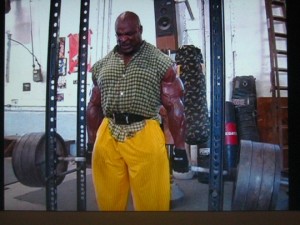

Remember, feel the muscle with continuous tension, not slow-mo reps. That’s how DXO can supercharge the mass-building effects of some exercises. X Reps at the end of a standard set can get you there too, but with a different grand finale firestorm. DXO gives you semistretched overload between every rep that fans the flames. Sure, you’ll have to endure a little pain, but that’s what it takes to gain—big time! Oh, and did we mention that muscle burn can increase growth hormone production, which can burn bodyfat like crazy? It all means that continuous tension will help get you big and ripped—fast!
Note: The big Beyond X-Rep Muscle Building e-book contains more information and variations of Double-X Overload training as well as other X-hybrid mass-building tactics, including X Fade, X/Pause, Stage Sets and X-centric Training. It also contains the exact Ripping Phase program we used to get bigger and better the year after our first X-Rep experiment. Bonus: There’s an entire chapter devoted to our analysis of Ronnie Coleman’s training and some of his techniques you can use to get huge. Bonus 2: The last chapter is “The Inner Workings of Steroid: Mimicking Their Anabolic Power Without Drugs,” a must-read for all mass-seeking weight trainers.