Q: I’m now a believer in negative-accentuated sets for fat loss. I started using a version of your Ultimate Fat-to-Muscle Workout and got leaner and more muscular after only one month. I admit that I did a few more NA [negative-accentuated] sets for areas I really needed to reduce fat. I’ve heard that spot reduction isn’t possible, but I could swear I lost more fat in those areas like my midsection and thighs that I hit with more NA work. I’m seeing abs! So do you think spot reduction is a myth? I’m starting to think not.
A: For those unfamiliar with it, an NA set is one second up on the positive and six seconds down on the negative. For example, on a curl, you would curl the weight at normal speed, then lower slowly to a count of six. The slow negative emphasis increases blood flow to the muscle and also triggers more muscle trauma. Both of those factors are critical to fast fat-to-muscle results…
That muscle trauma is key because it requires more “energy” to repair it. That’s why your metabolism is higher and you burn more fat for days after your workout. We’ll get to the importance of blood flow in a moment. First…
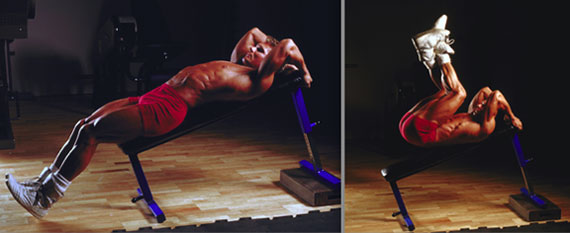
The question becomes, Does the energy required come from surrounding fat? For example, say you do NA sets for your abs—on incline knee-ups, you raise your legs in one second and lower in six. Do the excess calories necessary for repair after the workout come from abdominal fat?
While many studies suggest that spot reduction is a myth, in our X-treme Lean e-book we suggested that it could be possible TO A DEGREE:
Lack of blood flow to an area on your body can hamper fat loss there. So high reps [longer tension time] may help. It’s kind of a round-about spot-reduction strategy—or at least a more targeted fat-loss-acceleration technique.
According to respected researcher Mauro Di Pasquale, M.D., his belief in spot reduction has changed as well. This is from his Dr. D’s Elite Performance Newsletter, Vol. 1, No. 3:
I did finally find a seminal study published in 2007 (Am J Physiol Endocrinol Metab. 292(2):E934-9.) that for me definitively shows that exercising muscle does have an effect on local fat and especially the subcutaneous fat adjacent to the muscle. The study concluded that ‘an acute bout of exercise can induce spot lipolysis and increased blood flow in adipose tissue adjacent to contracting skeletal muscle.’
What this means is that you can reduce subcutaneous fat over a specific area in your body by exercising the muscles in that area. For example if you want to reduce abdominal fat, it’s useful to do abdominal exercises. However, keep in mind that, even though this study found that blood flow and lipolysis are stimulated more in adipose tissue adjacent to contracting muscles than in adipose tissue adjacent to resting muscles, whole body exercise, whether aerobic or RT, will result in more overall bodyfat loss than working local muscle groups.
What that means is that you should still do some cardio, as you will lose more body fat overall with whole-body workouts. BUT if you add to specific bodypart exercise, like for the abs, you can increase the fat loss SOMEWHAT MORE in that area due to an increase in blood flow and tapping into surrounding fat stores.
For example, you added NA sets for specific areas like your midsection. That no doubt helped because increasing muscle damage via negative-accentuated exercise can have some spot-reducing effects and amplify the fat-burning ability of high reps that are also included in the Fat-to-Muscle Workout.
Also, longer tension times of both NA sets and higher-rep sets produce a fat-to-muscle effect as well. Both NA sets and high-rep sets keep the muscle under tension for long periods—close to a minute—and induce muscle burn. That lactic acid burn releases more growth hormone, a potent fat burner. That’s why we include BOTH negative-accentuated sets and higher-rep sets in The Ultimate Fat-to-Muscle Workout and why it’s worked so well for you.
Incidentally, muscle burn and longer tension times are also why the 4X method has a very good fat-burning edge as well as amazing muscle-size-building abilities—another reason many pro bodybuilders have used it for contest prep. The 30-second rests between sets heighten muscle burn for GH release as well as blood flow to grow.
Till next time, train hard—and smart—for BIG results.
—Steve Holman and Jonathan Lawson
www.X-Rep.com
NEWEST RELEASE:
The Anabolic After-40 Muscle-Size Manual contains new mass-building XRX workouts featuring Pure Positions of Flexion mass training with moderate-weight 3X density sequences plus rest/pause X-Reps. In addition, you’ll get 3 FREE bonuses—“20 Pounds in 10 Weeks Blueprint,” “Anabolic After-40 Bodyweight Edition,” and “X-traordinary Arms.” Add them all to your mass-building library for a limited-time price ($100 value) of ONLY $15 HERE.