You want big arms that resemble 20-pound hams hanging by your sides and streaked with vascularity for maximum eye-popping impact? Of course you do! That’s why we’re addressing a number of questions that need to be answered if you’re going to get the insane arm gains you deserve…
Q: You list incline curls as the stretch exercise you’re using in your biceps program [in the Beyond X-Rep e-book]. You’ve said that stretch overload has created 300 percent increases in muscle mass in only a month [in research studies], so I want to make sure I’m doing this important stretch exercise right. Should I alternate arms on these? Should I twist my hands as I curl? Also, how low should the bench be?
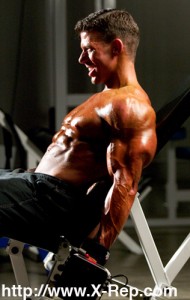 A: The best way to do incline curls is with simultaneous action—curl with both arms at the same time. Why? It has to do with the myotatic reflex, a key emergency response in a muscle that activates more muscle fibers—and it may be partially responsible for hyperplasia, or fiber splitting, which may have helped produce that triple-size muscle gain in the study you spoke of. The myotatic reflex is triggered when the muscle is stretched and then suddenly forced to contract. You can make that happen optimally by lowering the dumbbells with both arms at the same time and, when you reach the point at which your arms are almost straight, quickly reverse the movement. Don’t jerk or throw the dumbbells; just make sure it’s a deliberate action at the bottom with no pause. Move quickly but with control!
The myotatic reflex is also why you should keep your palms facing forwad—no hand twisting, or supination. That palms-forward position provides the most biceps stretch at the bottom. If you turn your hands to where your palms are facing each other, it relieves biceps stress and brings in the brachialis, a muscle that snakes under your biceps (train that muscle separately, as we described in our e-zine). Remember, keep your palms facing forward for the most biceps-fiber activation.
Also, don’t let your upper arms move forward much, if at all. In fact, you should reverse the upward movement of the dumbbells when your elbows break 90 degrees. That’s just above the halfway point, which will insure that you keep tension on your biceps. And don’t pause at the top either. Remember, while stretch overload is a key mass builder, continuous tension is also extremely important for maximizing muscle growth [see the occlusion studies in the Beyond X-Rep e-book for more].
Okay, now about the angle of the bench: You should start with a fairly high angle at first, as your biceps may be somewhat stretch challenged (most people don’t do incline curls—too bad). Set it at above 45 degrees so that your upper arms still move far enough back behind your torso that you feel a stretch in your biceps at the bottom of the stroke. After a few workouts try lowering the bench somewhat. Use that lower angle for awhile before going another notch lower.
Lowering the bench more than 45 degrees can produce more stretch in your biceps, but it may also create shoulder pain. We use an incline right at 45 degrees. Arnold, however, used to use a bench set pretty low—it looked like about 30 degrees in some of the photos. You don’t have to go that low to get maximum growth effects from incline curls. Just be sure you use a simultaneous pistonlike action, firing the muscles deliberately at the bottom of the stroke on every rep. By the way, the Double X Overload technique, discussed in Beyond X, works extremely well on incline curls—that’s an X-Rep partial at the bottom between each full reps. Although you’ll have to lighten the load a bit, the hitch at the bottom may be even more effective at triggering the fiber-activating myotatic reflex.
Q: I read that Arnold’s number-one biceps exercise was cheat curls. I’ve even seen photos of him leaning way back with heavy weights. Can I use cheat curls as my first biceps exercise for big arms?
A: Yes, you can, but it’s a gamble. Cheat curls put your lower back in an injury-prone position. There’s no doubt that cheat curls overload the key max-force point, near the bottom of the stroke, which can result in rapid biceps mass accumulation; however, a better, safer way to get that critical overload is with X-Rep partials near the bottom of the stroke at the end of a strict, continuous-tension set.
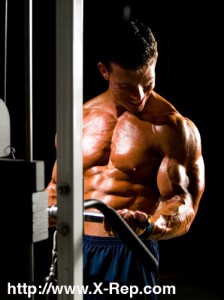 Unfortunately, due to an extreme leverage shift at the bottom of a free-weight curl, X Reps are impossible—with a barbell. We prefer to use cable curls, which minimizes the leverage shift and will allow you to do those important X-Rep partials at the end of a set. Try it: Do a strict set with a weight with which you can get 10 reps; when another full rep is impossible, lower the bar to just below the midpoint of the stroke and pulse through a six-inch range, pulling up to the halfway point and then back down, for as many X Reps as possible (see Jonathan’s to the left).
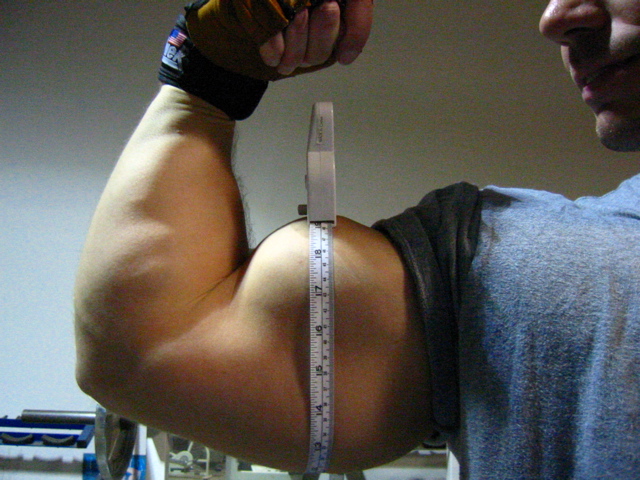
At first you may have to use a static hold instead of X Reps. That’s fine, but do use a pulsing action once you get your neuromuscular efficiency up to speed, as movement has been shown to be essential for maximum fiber activation via nervous system stimulation. Using extended-set techniques like X Reps is one of the big reasons Jonathan got his arm measurement up to 19 1/4 inches using only about five total sets for biceps (see the photo below).