Q: You did a good job of explaining the research on area-specific muscle-fiber growth from Chris Beardsley. I know Doug Brignole is a fan of Beardsley, so why does he disagree with the idea that a fiber can grow in different areas depending on the applied stress? Even researchers like Brad Schoenfeld, Ph.D., agree that it’s how growth happens.

A: I mentioned that I’m not completely convinced when it comes to area-specific muscle growth, but I’m willing to experiment with the idea. Why are so many researchers onboard with it?
It may be that most of these science types are looking at the same limited research through a narrow lens, so they come to the same conclusions…
Of course, the muscle-morphing observations could be true. Brignole flat out disagrees, and he makes some excellent points to the contrary…
1) How could a muscle contract more at one end, and not the other end? A muscle’s function is to move the origin and insertion closer together, thereby producing skeletal movement. Having part of a muscle contracting less than the other end defies its function. There is no way that it makes sense, from a function standpoint. WHY would a muscle do that?
2) If it were possible for one end to contract more than another end, how much more does it do it? If the increased contraction is 2 percent more, would that produce visible muscle growth in that area?
Doug goes on to say, “My biceps, triceps, pecs, delts, quads, hams, etc., are all the same exact shape they’ve always been (except for the muscles that have been injured, like my calves).
“Every way that you alter an exercise causes a mechanical change of some kind. You could change the range of motion (the amount of stretch and/or amount of movement); the position of the secondary joint; the direction of anatomical motion; the direction of resistance (the resistance curve); the angle at which the operating lever (limb) interacts with resistance, etc. But every one of those has an “ideal”; subsequent options that are progressively less ideal are just that—less than ideal.
They move away from that precise optimal set of parameters.”
That’s a lot to ponder, so I’ll leave it there. My thanks to Doug for weighing in. As I said, good points that keep me riding the fence on this. I can only go by what I’ve observed and what I gather from researchers who dedicate their lives to looking at this stuff…
I’m sure I’ll have more on this in future newsletters. What? Doug has an opinion on Larry Scott changing the shape of his biceps? Okay. Let’s do that tomorrow.
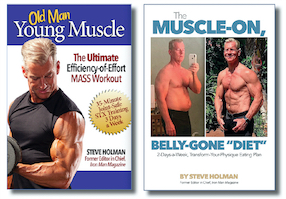
New: Get the ideal exercise for each muscle, the best add-on moves for ultimate mass, complete 35-minute workouts, exercise start/finish photos and details on building muscle fast and efficiently in Old Man, Young Muscle.
And you still get The Muscle-On, Belly-Gone “Diet” ebook FREE for a limited time when you add Old Man, Young Muscle to your mass-building library. Go HERE.
Till next time, train hard—and smart—for BIG results.
Steve Holman
Former Editor in Chief, Iron Man Magazine
X-Rep.com
Highly Recommended…
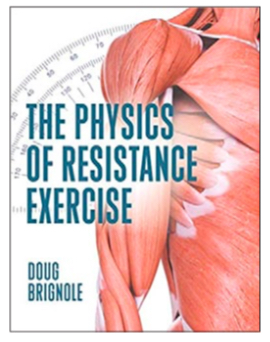 This is Doug Brignole’s incredible 400-page, large-format text on the biomechanics of exercise. It’s a guide to get you training correctly and building maximum muscle safely and efficiently.
Doug’s analysis and explanations on the science and logic behind muscular movement will show you why many of the so-called fundamental mass-building moves are inefficient time-wasters. Plus, he’ll show you the best alternatives.
Whether you’re a hobby bodybuilder, competitive athlete or personal trainer, this book is a must read, one you will refer to again and again throughout your training career.
Add it to your mass-building library HERE.