Many bodybuilders think they need to train with ultra-heavy weights to get big…
While you will grow, hypertrophy may be slow—at least slower than training with moderate poundages for more reps.
A study verified that by comparing two groups using a handful of basic exercises—bench press, squat, pulldown, etc.—three times a week (Schoenfeld, et al. J Sports Sci Med. 2016):

Group 1: 3 sets per exercise, 2-4 reps per set
Group 2: 3 sets per exercise, 8-12 reps per set
All sets were to failure, and all subjects were resistance-trained males.
Also, poundage for each exercise was adjusted upward if the subject got more than the prescribed reps for their group.
Results: The moderate-weight group built more muscle, more than double the heavy group in the biceps and quads; however, the heavy group built more strength, 4 percent more in the bench press and almost 15 percent more in the back squat.
It appears that heavy-weight training helps develop neuromuscular efficiency faster, which translates to strength without extra muscle.
Also note that the heavy group was using only 2 to 4 reps per set, which is 6 to 12 reps per exercise total at each workout, while the moderate group got 24 to 36 reps per exercise…
That means the moderate group trained an array of fiber types—from slow-twitch to fast-twitch—which may account for extra growth.
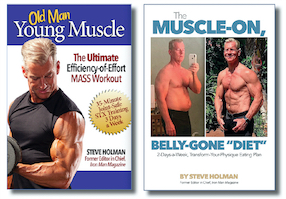
It’s why the Old Man, Young Muscle workout is moderate-weight training with short rests between sets. The goal is optimal hypertrophy as quickly as possible…
The OMYM workout also emphasizes the ideal exercise for each muscle, which amplifies the growth response.
Your Efficient Mass-Building Handbook: For more mass-building tips like the above plus complete workouts that include the ideal exercise for each muscle and the best stretch and contracted add-on moves, get your copy of Old Man, Young Muscle.
And you still get The Muscle-On, Belly-Gone “Diet” ebook FREE for a limited time when you add Old Man, Young Muscle to your mass-building library. Go HERE.