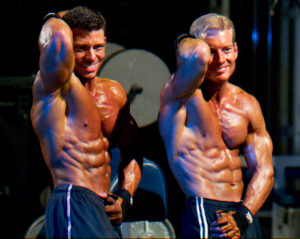
Before we get to the question, which involves training, we need to hammer home one fact: No matter how developed your midsection is, if it’s covered with a layer of fat, your results will not be visible. In other words, you have to train hard AND eat right if you want to display acid-etched abs. We know that from experience. It took the right combination of hard work and diet for us to rip up into this condition…
Now for the question…
Q: I’ve noticed and read in some of your articles that it’s best to do leg-raise exercises first in an ab program. Why not do crunches first to really isolate and burn the abs before moving to those inferior hip-flexor exercises?
A: First, most leg-raise exercises are not inferior to crunches; they are compound moves necessary for fast abdominal development. For example, think of incline leg raises as an ab exercise comparable to squats for your quads. Squats involve the glutes and lower back, which synergize with the quads; incline leg raises involve the hip flexors, which synergize with the abdominals. The crunch, on the other hand, is similar to leg extensions—more isolated.
So if you had to pick only one quad exercise, which would it be? Squats, of course, as they are much more effective at developing the upper-thigh muscles than the more isolated leg extension (muscles work best as part of a team—it’s just how the human body is constructed). Okay, back to abs: Does that mean you should skip crunches, and just do incline leg raises? No, it’s best to do them both if you want the fastest results possible—and you should do leg-raise-type exercises first. Here’s why:
Studies indicate that most hip-curl exercises, like incline knee-ups, train the entire rectus abdominis hard with an emphasis on the lower section. Crunches and other isolated torso-curl exercises, on the other hand, tend to train less of the muscle, mostly the upper section but are necessary for fast complete development because of that upper-area focus.
What happens if you do full-range crunches first? You’ll fatigue your upper abs, with less total muscle involvement. Then when you go to incline leg raises or knee-ups, your upper abs will be so fatigued that you won’t be able to do justice to your so-called lower abs. You’ve lessened the effectiveness of the more important exercise, incline leg raises, and de-emphasized and maybe completely derailed lower-ab delineation—which is damn hard to get for most people (and maybe that’s why—because everyone is doing crunches first or using only crunches in their ab programs; you need leg raises up front!).
So the rule is: Always work the lower area first with incline knee-ups or leg raises, which actually brings both upper and lower sections into play—and activates the most muscle fibers. Then move to your full-range-crunch exercise.
You may have noticed that we keep mentioning incline leg raises or incline knee-ups as the key compound exercises for the abs. What about hanging knee-ups? If you’ve read our e-books and/or have been reading our e-zine for a while, you know the importance of the semi-stretched position, the point on an exercise’s stroke where the target muscle is almost, but not quite, fully elongated. That’s near the turnaround point, where the rep goes from negative to positive. Now, think about hanging leg raises or hanging knee-ups…
Where is the abs’ semi-stretched point on either of those hanging exercises? At the bottom, when your legs are on the same plane as your torso. Is there resistance there? Nope. It’s a lot like a strict standing barbell curl—there’s very little resistance at that key spot on the stroke where maximum force occurs.
Arnold used to overload that key biceps sweet spot with heavy cheat curls—leaning back as he curled to hit it with resistance in order to blast more fibers. But you can’t do that on hanging leg raises. Moving the hips forward so the torso is angled back is best accomplished on a slant board. In other words, you have to change the exercise to incline knee-ups so there is resistance at the low semi-stretched point.
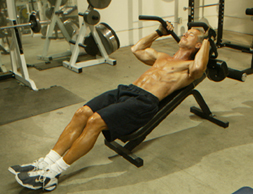

That one adjustment to your ab program can double or triple your results and have you flashing a set of acid-etched abs every time you peel off your shirt—if you peel off the bodyfat too.
[Note: For more key ab-training observations, as well as a number of time-saving ab-etching programs, see the X-traordinary Abs e-book.]

Till next time, train hard—and smart—for BIG results.
—Steve Holman and Jonathan Lawson
www.X-Rep.com