So training to all-out failure does get to the most fast-twitch fibers, but it also produces the most stress and damage, specifically on the last rep…

That can be bad for hypertrophy because you use too much of your growth resources to repair excess damage.
So too much damage means you don’t recover between workouts; you’re just spinning your wheels—working out again with little to no growth from your previous workouts…
It’s the reason so many bodybuilders make such slow progress…
A few ways around that is lower-volume workouts. Train intensely, then get out of the gym. As Mike Mentzer says, every additional set after the first digs into your recovery resources and adds to the damage:
Remember, the issue of volume in anaerobic exercise is a negative factor. Your purpose is NOT to see how many sets you can do or how long you can endure; your purpose is to do the precise amount of exercise required to stimulate growth. Then get out of the gym, go home, rest and grow.
So efficiency and precision in your shorter workouts is key to trigger growth while limiting damage. At age 64, I need to get it done in three to four sets per muscle twice a week…
If you’re younger, have excellent recovery ability, and/or are taking steroids, you can probably get away with more. But do you really need it?
Mentzer would say absolutely not. He settled on one or two sets per muscle for his clients and manipulated the rest days between workouts—more if you were recovery challenged…
You could try that; however, I like training on specific days of the week—although I have been known to skip a workout if I’m feeling overtrained…
As for adding or subtracting sets, that depends on the individual. And it’s an ongoing moving target that can shift depending on life stresses, age, nutrition, sleep, illness, etc.
Even so, there are some blanket recommendations to help make your workouts produce more growth faster with less damage in the fewest sets possible (35-to-45-minute workouts three days a week, as in Old Man, Young Muscle)…
1) Do only your first set of your ideal exercise with high reps—around 20—as higher reps produce more fatigue which has been shown to amplify damage.
2) Follow with a Speed Set —1.5-second reps. That gets at more fast-twitch fibers without excess damage.
3) Take your high-rep set to failure, but stop most others one rep short.
4) Keep your volume fairly low for each muscle—I like three to four, but you may want or need more if your recovery is above average, you’re young, you’re on steroids, or you’re a gorilla.
5) Train only three to four days a week; recovery days are necessary for systemic recovery as well as muscle repair.
6) Take a downshift week with low intensity sets every four to six weeks; that can work wonders to heal your muscles from damage accumulation and allow new growth to happen.
Tomorrow we’ll see what the research says on fast vs. slow reps with a quote from Chris Beardsley and how it applies to your workouts…
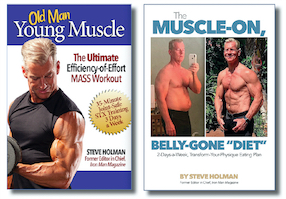
Your Efficient Mass-Building Handbook: For complete mass workouts that include Speed Sets, the ideal exercise for each muscle, and the best stretch and contracted add-on moves, get your copy of Old Man, Young Muscle.
And you still get The Muscle-On, Belly-Gone “Diet” ebook FREE for a limited time when you add Old Man, Young Muscle to your mass-building library. Go HERE.
Till next time, train hard—and smart—for BIG results.
—Steve Holman
Former Editor in Chief, Iron Man Magazine
www.X-Rep.com
FREE Protein!
One of our favorite proteins has a try-it-free, no-strings offer, and we don’t want you to miss out. No, this is not a trick or scam—it’s simply a way for BioTrust to get you to try their great Low-Carb protein, no strings whatsoever (just pay a small shipping cost). We’re not kidding…This is an incredible offer, but there’s a limited supply, so grab yours today before the offer runs out** —and it’s delicious, by the way!
–> Secure Your FREE Container NOW! (limited inventory)
**One free container per household