Q: I don’t have a lot of time to train, which is why I look to you for info. All of your techniques and workouts revolve around efficiency, which is great. I can’t afford to waste time. My question is about back training. When I do a 3D POF lat routine, doesn’t my midback get plenty of work too? And isn’t the opposite true as well: When I train midback, don’t my lats get enough stimulation? I just don’t want to do extra work that’s not necessary. Every minute I’m in the gym must count.
A: We hear you. We squeeze our training into a limited schedule, so our primary concern is efficiency-of-effort muscle building. That’s why we try a lot of things and discard what doesn’t work, constantly refining our workouts.
You bring up a good point about back training—there is a lot of overlap between lat and midback work. You may want to decide which is the weaker area and do a full 3D POF program for that muscle group, then simply add one efficient exercise for the other area. For example, say your lats need more attention. Here’s a good 3D POF lat routine with a potent midback exercise added to the end…
Midrange: Wide-grip chins, 2 x 9-12
Stretch: Dumbbell pullovers, 1-2 x 9-12
Contracted: Stiff-arm pulldowns 1-2 x 9-12
Midback: Two-arm dumbbell rows, 2 x 9-12

As we discuss in the back chapter in the 3D Muscle Building e-book, the two-arm dumbbell row is a very efficient midback exercise. The hands move close together at the bottom of each rep, which stretches the middle trapezius, your hands move apart as you pull to the top, which allows you to squeeze your scapulae (shoulder blades) for midback contraction, and you’re using your arms and lats for synergy, which allows a heavy overload. You get some stretch-, contracted- and midrange-position work all in one midback exercise. Very high efficiency-of-effort.
If you can, use chest support, as that will keep momentum in check. If you can’t use chest support, just do standard bent-over two-arm dumbbell rows and keep your torso angled up, slightly above parallel to the floor. As you row the dumbbells—whether you use chest support or not—keep your arms angled out away from your torso so your shoulder blades can move together at the top. If you row with your arms close to your body, your lats become the prime movers.
What if your midback is the weaker of the two areas? You’d do a full 3D POF midback program like this, with an efficient lat exercise to finish…
Midrange: Shoulder-width cable rows, 2 x 9-12
Stretch: One-arm dumbbell rows, 1-2 x 9-12
Contracted: Bent-arm bent-over laterals, 1-2 x 9-12
Lats: Shoulder-width-grip undergrip pulldowns, 2 x 9-12
Undergrip pulldowns are to lats what two-arm dumbbell rows are to midback. The undergrip allows some lat stretch at the top and max contraction at the bottom, plus it puts the biceps in a strong pulling position for synergy and overload.
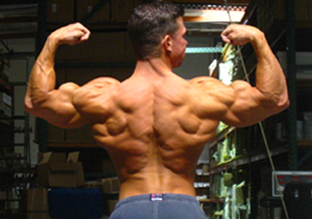
Incidentally, you could alternate those two programs, giving lats the most attention at the first workout and midback the full-on hit at the second. We’ve used many 3D POF programs to train our midback and lats for years. There are a lot of great variations. Does it work? Jonathan’s back double-biceps pose says yes…
Till next time, train hard—and smart—for BIG results.
—Steve Holman and Jonathan Lawson
www.X-Rep.com
Note: Every muscle gets a 3D Positions-of-Flexion analysis and complete full-range program in the 3D Muscle Building e-book.