I want to revisit something I called attention to in a past newsletter: the volume threshold for muscle growth. To review…
According to Richard Winett, Ph.D., a recent joining together of experts from multiple countries looked at empirical studies and systematic reviews on muscle hypertrophy…
One of the conclusions had to do with total sets per muscle over the course of each week. Here is their conclusion…
“A dose of approximately 10 sets per muscle per week would seem to be a general minimum prescription to optimize hypertrophy, although some individuals may demonstrate a substantial hypertrophic response on somewhat lower volumes.” (IUSCA)

That 10 sets a week is a blanket recommendation that has a lot of variables…
Are you performing all of those sets correctly?
Are you using a variety of rep ranges?
Are you using sets with different rep speeds?
The late Charles Poliquin, legendary muscle-training expert and Olympic coach, said that sets with different rep tempos is the most neglected hypertrophy trigger in bodybuilding.
But I’d say the biggest question when it comes to proper volume for maximum muscle is…
Are you using the ideal exercise for most of those 10 sets?
Through biomechanics analysis and physics, Mr. America and Mr. Universe winner Doug Brignole has identified the ideal exercise for each target muscle (I explain many of them in the new ebook)…
Those are the moves that have the target muscle contract through the proper arc of motion, line of force, and with the proper strength curve to activate the most fibers.
If you’re not emphasizing those exercises, you may need a lot more sets to get optimal muscle-growth stimulation; and if you are, you may need fewer than 10 sets a week…
For example, if you’re doing a band chest press, we know that bands have a backward strength curve—too easy at the stretch point when the most fibers can fire and too hard at contraction when the muscle fibers are bunched together causing inefficient activation…
You no doubt need a lot more than 10 sets of that exercise, which ranks about a 5 on the ideal scale…
On the other hand, a dumbbell decline press checks off almost all the boxes on the ideal-exercise chart, so you may need 10 sets a week or even fewer for chest mass if you are emphasizing it in your workouts…
Here’s something else to ponder: Many of the top bodybuilders do 20-plus sets per muscle group, insisting they need that much to get massive; however, most are using very inefficient exercises, rarely emphasizing the ideal…
And that includes Arnold back in the day who favored T-bar rows, barbell bench presses, and barbell squats, to name a few—all inefficient for optimally activating the maximum number of muscle fibers in the target muscles.
Could he have been as good or even better with fewer sets and less time in the gym if he had emphasized the ideal exercises with the same effort and intensity?
It’s something to consider when it comes to your workouts.
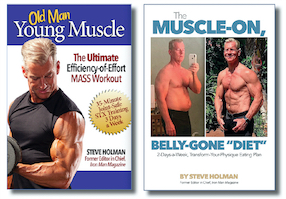
New: Get the ideal exercise for each muscle, the best add-on moves for ultimate mass, complete 35-minute workouts, exercise start/finish photos, and details on building muscle fast and efficiently in Old Man, Young Muscle.
And you still get The Muscle-On, Belly-Gone “Diet” ebook FREE for a limited time when you add Old Man, Young Muscle to your mass-building library. Go HERE.
Till next time, train hard—and smart—for BIG results.
Steve Holman
Former Editor in Chief, Iron Man Magazine
X-Rep.com
Highly Recommended…
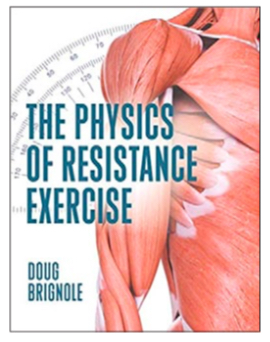 This is Doug Brignole’s incredible 400-page, large-format text on the biomechanics of exercise. It’s a guide to get you training correctly and building maximum muscle safely and efficiently.
Doug’s analysis and explanations on the science and logic behind muscular movement will show you why many of the so-called fundamental mass-building moves are inefficient time-wasters. Plus, he’ll show you the best alternatives.
Whether you’re a hobby bodybuilder, competitive athlete or personal trainer, this book is a must read, one you will refer to again and again throughout your training career.
Add it to your mass-building library HERE.