In my rants about physique aesthetics and symmetry, I referenced Steve Reeves a few times…
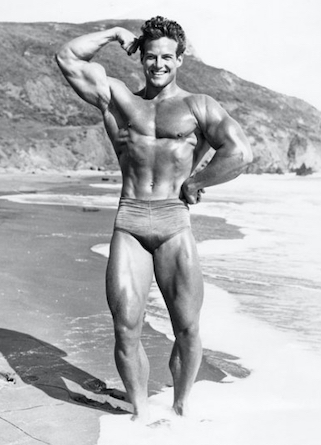
He won the Mr. America in 1947 and went on to play Hercules, as well as gladiator heroes, pirates, and even cowboys, on the silver screen. Being a handsome guy certainly helped, but so did his physique…
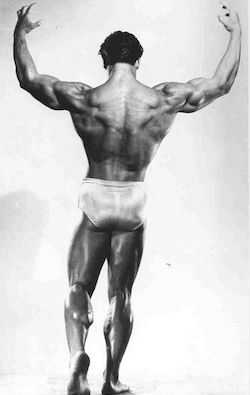
He had a rugged thickness but with perfect proportions—a walking work of art.
One of his priorities was wide shoulders with capped deltoids. He knew that was a big part of looking like a bodybuilder—width.
A key training tip from Hercules himself was to always train shoulders first. Prioritize for size.
His upper body training was shoulders to chest to back to biceps to triceps.
The order is important because you move growth-promoting blood to muscle groups that are in close proximity to each other.
He believed it would be inefficient, for example, to train chest, calves, back, thighs, forcing the blood to “travel.”
He trained with full-body workouts three days a week, hitting legs after upper body.
He also used very little rest between sets to enhance the pump and intensity to train as many muscle fibers as quickly as possible.
That’s similar to the STX method in Old Man, Young Muscle, in which you train an array of fibers, building the mass of the muscle in a matter of minutes.
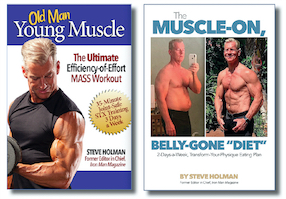
Sculpt your perfect physique: Get the ideal exercise for each muscle, the best add-on moves for ultimate mass, complete 35-minute workouts, exercise start/finish photos, and details on building muscle fast and efficiently in Old Man, Young Muscle.
And you still get The Muscle-On, Belly-Gone “Diet” ebook FREE for a limited time when you add Old Man, Young Muscle to your mass-building library. Go HERE.
Till next time, train hard—and smart—for BIG results.
—Steve Holman
Former Editor in Chief, Iron Man Magazine
www.X-Rep.com
Recommended:
Tight Hips Can Slow Muscle Growth, Damage Your Back, and Even Make You Look Fat
 Whether it’s from hanging kneeups, heavy squats, or sitting for long periods every day, you’ve successfully followed the formula for creating tight iliopsoas muscles…
That basically means damaged hips that trigger back pain and poor circulation (reduced lower-body pumps). Plus, tight hip flexors can even make you look fatter than you are…
One of the most significant things about the psoas (pronounced so-az), or hip flexor muscle, is that it connects the legs to the spine (see the illustration).
When the psoas is tight from sitting for long periods, your hips become fixed in a forward-thrust position, causing your pelvis and leg(s) to rotate…
That forward pelvic tilt can cause your hip socket to become compressed, leading to shifting of joints, tendons, and muscles with an often painful pull on your lower back.
That lower-back pressure will also decrease blood flow and circulation as well as delay nerve response to the hips. Poor circulation is never a good thing—you will be weaker in many exercises and poor blood flow below the waist can even negatively affects your sex life.
And as mentioned, the forward pelvic tilt also pushes out your stomach, giving you a protruding belly. Luckily, loosening your hips and hip flexors is simple with something called the “Sequential Flow Method.” Leading Kinesiologist and Injury Specialist Rick Kaselj, M.S., explains it and shows the flow design HERE.
You’ll also see how it can add 35 pounds to your deadlift almost instantly—unlock your hip flexors and unleash new strength.
By the way, Rick has given over 352 live presentations to more than 8,152 health professionals in the US and Canada. His “Unlock Your Hip Flexors” program is highly recommended. For more info, go HERE.