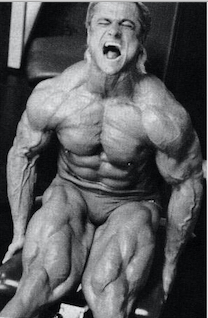
In the last training newsletter, there was a list of the reasons why contracted-position exercises, like triceps pushdowns and leg extensions, can be just as important as stretch loading for mass in some cases… [Read more…]
A Muscle’s Unique Mass Response, Part 1

Recent studies seem to place stretch-loading and stretch exercises at the top of the mass-building food chain… [Read more…]
Contracted Exercise Builds Muscle-Fiber Size

Studies continue to show stretch moves create more hypertrophy than contracted-position exercises. And they do—over a 12-week period. But… [Read more…]
Stretch + Contraction: Double Your Mass Reaction
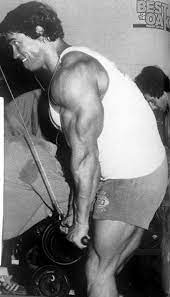
Q: You include both stretch- and contracted-position exercises in the Old Man, Young Muscle workout. I get why that can build more mass. But since so many studies are showing that stretch loading builds the most muscle, should I rely more on the stretch moves, or maybe even eliminate the contracted exercises most of the time?
A: The jury is still out on whether stretch exercises are “superior” to contracted-position moves. How is that possible since studies clearly show that—for example, overhead extensions beat pushdowns hands down—or in this case, hands up—for triceps mass? [Read more…]
Stretch Best for Mass? Maybe Not…

You’ve no doubt seen all the studies showing that stretch-loading builds muscle mass significantly faster than contraction emphasis… [Read more…]
Contracted-First Mass-Burst Workout

In Chapter 9 of Old Man, Young Muscle, you’ll find the Stretch-First POF Workout…
It’s a great variation from using the ideal exercise first, as you start with the important full-stretch range with high reps—for example, dumbbell flyes first for 20 reps followed by the ideal chest move, decline presses for two sets—10, 7. [Read more…]
Contraction Mass Reaction
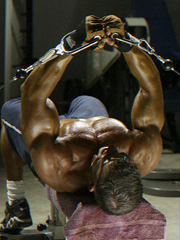
With all the talk about stretch loading being the best for hypertrophy, and the inferiority of contracted-position exercises, some bodybuilders are throwing out the contracted-position moves… [Read more…]
Is Stretch Loading All You Need for Mass?
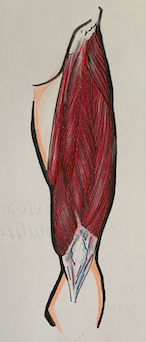
Yesterday’s newsletter contained an overview of a new study…
“Partial Range of Motion Training Elicits Favorable Improvements In Muscular Adaptations When Carried Out at Long Muscle Lengths.” [Eur J Sports Sci. Pedrosa, et al. 2022] [Read more…]
Study: Pounds of Muscle After One Workout (Yes, One Workout)

Q: In the “X Factor” interview at X-Rep.com, Jonathan says you guys tried a static contraction at the end of isolation exercises with only mediocre size results. But I just got the X-Rep Update #1 e-book, and you’re recommending them. Why have you found static holds more effective now than in the past?
A: When we first used static contraction many years ago, we did them on contracted-position exercises, like leg extensions, holding the flexed position for as long as we could after full-range exhaustion. That’s a hold after a number of regular reps. We got good gains, but later that hold at the end of a set evolved to X Reps on the big midrange exercises instead of isolation moves, and that worked much better at building bigger, fuller muscles.
[Read more…]When doing a drop set, why do you go to failure and then do the bottom portion of X-reps first. Wouldn’t it make sense to do your set to failure, do the top contracted position first with X Reps, reduce the weight, and then do full reps to failure followed by X Reps at the bottom.
A: We do a lot of X-Rep variations. We’ve even tried ones similar to that. For example, on leg curls we’ll do a set to failure, get help to the contracted position and pulse there; at X-Rep failure we lower to the midpoint and pulse there. We finish with X-Rep pulses at the max-force point, near the bottom of the stroke. The problem with that (and your version as well) is fatigue. By the time you reach the max-force point, the most effective spot for fiber activation, the muscle will be riddled with lactic acid and not be able to fire effectively. Our preference is to do the first phase of a drop set with X Reps at the max-force, to hit that key sweet spot with as much intensity as possible. That takes full advantage of the size principle of fiber recruitment as explained in The Ultimate Mass Workout. Then we’ll do the second phase of the drop with contracted-position X Reps at the end or an X Fade. If we do a second set, we may experiment with different variation.
So the answer to your question is, we’ve found it’s best to hit the max-force point when fatigue isn’t red-lining. It’s the most important point on the stroke, so give it priority most of the time.