
Holy pump! Chest and back were on fire and stretching my shirt as far as it would go. Pays to wear your 5-year old’s clothes, I guess. LOL!… [Read more…]
X Factor Interview, Part 2

Note: The X Factor Interview is an excerpt from Iron Man Magazine.
What if you could pack on a solid five pounds of muscle almost every month? What would you look like one year from now? Are you kidding? Your physique would be outrageous! Radically different and unrecognizable because of so much extra muscle hanging off your joints. Well, in my estimation, Jonathan Lawson added at least five pounds of muscle to his already advanced physique in only one month—not one year, one month—and he’s been training for about 15 years. Add to that the fact that he did it while he was on a a low-calorie diet, and you can see the enormous muscle-building implications for you—especially if you’re not limiting calories, as he was. (Could you add even more, like 10 pounds of muscle, in one month if you followed his lead? Who knows?) [Read more…]
X Factor Interview, Part 1

Note: The X Factor interview is an excerpt from Iron Man Magazine.
Most readers know Jonathan Lawson as the younger half of IRON MAN’s “Train, Eat, Grow” crew—he’s 31, and his geriatric training partner, Steve Holman, IM’s editor in chief, is 45. These cats have been blasting readers with killer training info in their “TEG” series for more than five years—and they’ve been hitting the iron together for more than 10 in the IRON MAN Training & Research Center. Their motivation? It appears to be devising new methods of iron-based torture for us diehard bodybuilders to inflict on ourselves—from double-drop sets to stage sets to Hypercontraction.
They experiment with a lot of techniques, enthusiastically passing along what they find via the pages of IM. Why? To help readers build more muscle—and also to make sure we are screaming obscenities in gyms everywhere right along with them.
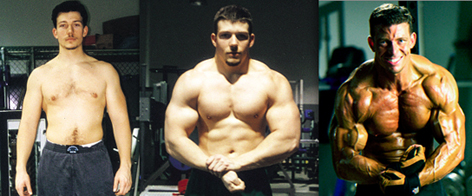
Recently they stumbled onto a new training concept that took their muscle size, shape and density to new dimensions—X Reps. You may have seen the before and after photos. Let’s just say that the muscular transformation it helped them achieve in only one month is crazy. (I just started using it, and I’m already noticing gains—and more obscenities.)
After perusing their Web site, www.x-rep.com, I decided I needed to know the inside story. Since Steve got pissed at me after I told him he was a wuss for not benching heavy anymore, I decided to hit Jonathan up with the big Q&A.
BL: You guys call it X Reps. Isn’t that false advertising? I had visions of training with hot porn stars.
JL: [Laughs] That could be fun, but very distracting. Actually, Steve came up with the name X Reps as an abbreviation for extended reps. He coined that term years ago when we tacked on an all-out static-contraction rep to the end of a set of isolation exercises. You know, just hold and squeeze at the top when you can’t get any more full reps. He mentions that version of X Reps in Size Surge 2. That technique recently evolved into a much more effective version.
BL: Before we get to that new and improved version, tell me about the static thing at the end of a set. It didn’t work?
JL: Well, a static contraction at the end of a set has its benefits—it’s pretty good at increasing the nerve-to-muscle pathways [neuromuscular efficiency]—but we never found it to be all that productive for building muscle.
BL: So why do you think more muscle didn’t happen with static contractions?
JL: For one, we used it on contracted-position exercises at the peak-contracted point of the stroke—for example, at the bottom of a cable crossover, when the pecs are fully flexed. According to a lot of research, that’s the weakest point in a muscle’s range. Some articles in IM on isometric training got us thinking about the concept again. That’s when we decided that X Reps should really be at the strongest part of the stroke for more force production and more overload. We also decided that maybe we’d get better gains doing those static reps on the big, multijoint exercises, like squats or bench presses. After all, you get more muscle synchronization with compound exercises and therefore more overload. Compound exercises train the muscles the way they’re designed to function—as part of a team.
BL: I get it. So instead of using a static contraction at the end of a set of crossovers, you decided to put it at the end of bench presses.
JL: Right, but then we had to figure out the best spot in the range of motion to do the static holds. For the big exercises we wanted the spot where we could get the most force generation possible from the target muscle. Most researchers believe force is the key growth trigger, so we wanted to overload that spot in the range for as much mass stimulation as we could get.
BL: Stop! Let me guess: For the bench press you put the X near the top, where you can get the hardest pec contraction. Right?
JL: A good guess, but no. On bench presses the top is almost all triceps. You’re right—that’s where the pecs are closer to full contraction, near the top of the stroke, but as I said, the contracted position is one of the weakest points in the range. Scientists say that’s because the muscle fibers are too bunched up to fire properly in the fully contracted position. That’s why it’s so difficult to get the handles down to the bottom of a crossover toward the end of a set—you’re stronger at the start of the movement, when there’s some stretch in your pec fibers. You could keep doing reps in that stretch position after full-range failure because it’s the strongest point in the range.
That extra strength is due to the fibers being lengthened and perfectly aligned. Some stretch in the muscle is best for maximum force production.
BL: Hey, I just thought of something. That means you do your X Reps for squats at the bottom, after a set to failure. Are you clinically insane?
JL: No, actually, we do X Reps on squats just above the middle of the stroke. There’s a leverage shift at the bottom of a squat, which makes that position the wrong one for maximum force production. Every exercise has its own sweet spot that’s best for X Reps, so you have to analyze each one individually. You can’t really generalize, although near the bottom of the stroke on most is a good place to start.
BL: I saw your before and after shots. You say they were taken one month apart, before you started X-ing and then one month later. It looks like you put on 15 pounds of muscle. How much did you really gain, and what drugs were you on?
JL: I’ve never taken steroids in my life. Both Steve and I were completely clean, although we were using a variety of supplements.
That’s one reason we were both a little skeptical when we started our experiment—a lot of intensity techniques only work for drug users. Also, we only experienced small mass gains when we used static contractions in the past, but we decided to give it one more go.
Luckily, we documented our progress up to our photo shoot last year—we took photos at about one-month intervals, beginning in March. The so-called before photos at the end of May were just part of our progress monitoring. We would’ve taken them even if we hadn’t decided to try something new. We started the X-Rep program right after we took those shots at the end of May. We reduced our sets slightly because of the extra X-Rep intensity, and—Bang!—our bodies started changing incredibly fast.
To say we were shocked is an understatement, especially when we took photos a month later. X Reps work—at least they did for us—in a big way. I keep telling anyone who will listen that they have to try the technique if they’re looking for more size.
Oh, you asked about bodyweight. I weighed about the same in both pictures, around 205, but as you can see, I added a lot of muscle and dropped fat during that X-Rep-training month. If I had to estimate, I’d say I gained more than five pounds of muscle and lost an equal amount of bodyfat—and that was on a reduced-calorie diet.
BL: Five pounds of muscle in a month—on low calories? And you’ve been training for how long?
JL: About 15 years—10 years with Steve at the IRON MAN Training & Research Center.
BL: That’s pretty damned impressive. So tell me how to use X Reps on bench presses, and then explain the science behind them—why the technique works.
JL: Ah, Steve said the bench press is your favorite exercise. We don’t do it at the moment because we’re wusses, according to some people. [Laughs.] Here’s what you do: First you rep out—getting close to failure. When you reach the top on your last rep, you lower the bar to just below the midpoint of the stroke and do partial pulses, firing off a group of minireps. Oh, by the way, your pecs will burn, so be prepared. And, obviously, if you don’t have a spotter, do them in a power rack because after your X reps, the bar is going down.
BL: What the hell is a minirep? Sounds like you’re working out with Dr. Evil’s midget double.
JL: [Laughs] I describe them as minireps because we went to partials instead of static X Reps almost immediately. Holds didn’t feel right, and as we’d experienced in the past, they didn’t seem to be very effective at building muscle. The new power-partial version, moving the bar a few inches up and down, is what worked so well for us. The science behind that makes sense: Muscles are used to movement, not static contraction, so to get the most out of the sweet spot of any exercise, you need some dynamic action for the best fiber activation. On some exercises it may be impossible to pulse at the sweet spot, so you can do a static hold—but try to pulse.
BL: You said sweet spot again—and dynamic action. Are you sure there are no porn actresses involved in this training method?
JL: Oh, I’m sure. I am more excited about training than ever thanks to X Reps, but that would take the X-citement to a whole new level. And our e-book would be called The Joy of X instead of The Ultimate Mass Workout.
BL: [Laughs] So you think X Reps worked so well during that month because you used movement instead of a hold at the right spot?
JL: Yes, and we did those power partials at the end of a regular set on a number of certain big, compound exercises—the mass moves. We experimented with them on isolation exercises also, which we discuss in the e-book, but I think the X Reps on multijoint exercises gave us the majority of our quick gains.
BL: I saw your explanation about why you do regular reps first, before you do X Reps. It was on your Web site’s home page. Can you refresh my memory, ’cause I got an itch to do heavy X Reps all by themselves.
JL: The reason we do regular reps first, before we move into X Reps, has to do with the size principle of muscle fiber recruitment. It’s a domino effect: The low-threshold motor units fire first, followed by the intermediates, followed by the high-threshold motor units. So the early, easier reps prime more fast-twitch fibers to fire toward the end of a set. Those early reps act as a kind of built-in warmup as well as training different fibers.
When you can’t get another rep, that’s nervous-system failure. Unfortunately, that’s right when key fast-twitch fibers start to come into play. It’s the reason bodybuilders do set after set after set—in an attempt to make up for that nervous-system roadblock. They add volume in an attempt to get more growth stimulation. But just doing more sets usually results in only small increases—and depletes too much energy. So to keep gaining with that method, you almost have to use steroids.
If you move into X Reps at the failure point, however, you continue to get fast-twitch fiber activation, and you don’t have to use nearly as much volume to flip on the growth switch. We proved that on ourselves. As I said, when we started using X Reps, we gradually reduced our sets because we could tell it was intense work and giving the muscle a unique stress. After that it was fast-track gains—we got more muscular at almost every workout. In fact, our progress came so quickly, we were forced to move up our photo-shoot date by an entire month. It all really cranked up our motivation. We were so excited every time we walked into the gym that our intensity snowballed.
BL: So let me get this straight. What you’re saying is that regular reps prime the muscle for X Reps so you can get more fast-twitch fibers to work at the end of a set?
JL: Yes. And another reason for doing the full reps first is that you train many more fiber types that way, which can help build maximum muscle size. You may even get some slow-twitch fibers in there on the first rep or two. The more fibers you can beef up, the more mass you’ll develop. Heavy X Reps alone would train only the pure fast-twitch fibers. I’ve seen research that lists more than five different fast-twitch types, so despite what some people say, making the fastest mass gains depends on developing all fiber types, not just the pure-strength fast-twitch ones. Supersets, drop sets and X Reps all contribute to that effort, and from our experience X Reps appear to be the most powerful of the bunch. We may have even stumbled onto a more productive version, X Overload. We’re experimenting with it now, and our results have been impressive.
Editor’s note: In part 2, Lawson elaborates on X-Overload training. He also outlines his ripping diet and discusses how to increase GH and testosterone production in the gym, forced reps vs. X Reps and how stretch overload may induce hyperplasia, or fiber splitting. Part 2 of Lawson’s interview is in the March 2005 issue of IRON MAN.
Read The X Factor Interview, Part 2 HERE.
The Ultimate Freak-Physique Workout?

Q: I got the Size Surge 2.0 and X-treme Lean. Really great info. Is the Size Surge Phase 2 Workout the one Jonathan used to get in ripped, freaky condition? I know the diet he used is in X-treme Lean, but there’s also a workout in that e-book. Is that the one? [Read more…]
Train to Failure? Muscle-Building Simplicity
Q: I just got the Size Surge 2.0 e-book. I see the two programs Jonathan used to build 20 pounds of muscle in 2 1/2 months has him using only one or two work sets per exercise, both work sets to failure. What does “failure” mean? Did he used forced reps? Negatives? Or just stop when he could no longer get a full rep?
A: Jonathan trained alone for Phase 1, which was a three-days-a-week mass-exercise anabolic primer. That means he couldn’t do forced reps or negatives… [Read more…]
How Much Muscle Per Month?

Q: The Size Surge e-book is one of my favorites. Solid programs and talk about motivation—Jonathan gaining 20 pounds of muscle in two months. Wow. The Super-Size Crash Course shows Jordon Williamson gaining 18 pounds of muscle in 12 weeks or so. Why did it take him almost a month longer to gain less mass than Jonathan, and how much muscle is possible per month? [Read more…]
Best Muscle-Growth Method for You
Q: I just started using the 4X methods. Great stuff. Loving the pumps, but I’m wondering if 4X is better for maximum muscle size or Downward-Progression 4X [adding weight each set so reps fall—12,10,8,6] – what’s the best muscle-growth method for me?
A: Both methods provide a powerful hypertrophic Density effect. That’s because you rest only 35 to 45 seconds between sets. That gets you to the critical growth threshold quickly… [Read more…]
One Quick Tip to Pack on Muscle Mass Fast (it hurts, but it works!)

Q: I just got the Size Surge 2.0 e-book (thanks for the great price). It’s excellent, but you don’t mention X Reps much. I know you said when Jonathan got his great results with the original Size Surge program, you hadn’t developed X-es yet. I’ve built a lot of mass with that technique, so should I include X Reps in either phase?
A: For the uninitiated, X Reps are short eight-inch partials at the end of a full-range set. We’ll give you an alternate end-of-set mass move in a moment, but first, here’s a quick explanation of X Reps… [Read more…]
Build Your Future Freak Physique Now

Q: Now that the weather has cooled down a bunch, I’m looking for a mass workout program for winter, to build as much size as possible. Then I’ll start to lean out in the early spring thaw. What type of program should I use? Big, basic power-bodybuilding routine or something like 4X Positions of Flexion? I can’t decide.
A: Winter is a long haul, so why not do both? A good place to start is with something like Jonathan’s Size Surge program—but you can do it with a few twists… [Read more…]
Lean-and-Muscular Winter-Workout Tips

Q: I’m using the four-day version of The X-traordinary 4X Mass Workout. Will that help me stay as lean as possible over the winter? In the past, I’ve had trouble in that area. I tend to blow up to a smooth fat boy over the holidays. Is 4X the way to go so I don’t chub up?
A: First, understand that no workout program will prevent you from becoming president of the Chub Club if you eat like crap all the time. We’re not saying you can’t enjoy some fattening foods and desserts every so often, but it sounds like you lose control. Moderation is the key. Stay on a healthy diet most days during the week, but allow one or two for splurges. Do NOT make junk meals an everyday occurrence. Imagine YOU in this picture to stay on track… [Read more…]